 PlantLegit
Native plant garden plans by ZIP code: layout, plant counts and calendar
Sources (11)
- USDA ARS Plant Hardiness Zone Map (2023)
- National Wildlife Federation Native Plant Finder
- Audubon Native Plants Database
- Virginia DCR Natural Heritage: Native Plant Finder
- USDA NRCS Web Soil Survey
- University of Maryland Extension: Soil Health, Drainage, and Improving Soil
- Native Plants for Southeast Virginia, including Hampton Roads (Virginia Coastal Zone Management Program / Plant Virginia Natives, 2nd ed. 2025)
- Virginia Cooperative Extension 426-043: Rain Garden Plants (Andruczyk & Fox; reviewed Jan 2024)
- Virginia Cooperative Extension SPES-13P: Stormwater Management for Homeowners, Fact Sheet 5: Rain Gardens
- Virginia Native Plant Society, South Hampton Roads Chapter
- Virginia Cooperative Extension: Find your local office
By Jacob Knapp, Virginia-licensed home inspector, Virginia Beach. Sources checked November 11, 2026. General guidance, not engineering or legal advice.
Free plant lists are everywhere. What's usually missing is the plan: which plant goes where, how many of each, and when to put them in. Here's how to build one.
Step 1: Find your zone from your ZIP
Your hardiness zone tells you which plants survive your winters. The USDA Plant Hardiness Zone Map has a ZIP code search, and so does our free zone lookup (2023 USDA map). Zone is the starting point, not the whole answer. As the Southeast Virginia guide puts it, the local conditions in your yard decide what grows best there (SEVA guide).
Step 2: Write down your spot
- Sun: full sun, part sun, or shade. Check it in the morning, at midday and in the afternoon.
- Water: does it stay wet after rain? Do a quick drainage test: a 12-inch hole, filled, refilled the next day, should drain within eight hours (UMD Extension).
- Soil: look up your lot on the free USDA Web Soil Survey, or get a soil test through your Extension office.
Soggy spot? Fix the water first: standing water in your yard: a home inspector's fix order.
Step 3: Pick native plants for that spot
Free places to start:
- NWF Native Plant Finder: search by ZIP for the native plants that host the most butterflies and moths where you live. The Audubon Native Plants Database suggests bird-friendly natives for your area.
- Your state or regional guide. In Virginia, the DCR Native Plant Finder filters by region, moisture and light. Near the coast, see native plants for Southeast Virginia & Hampton Roads. Other states: native plants by state.
- PlantLegit's free check: what fits your ZIP, and whether any plant is on your state's invasive or noxious-weed lists.
Choose plants with the same sun, soil and water needs for each bed. The Southeast Virginia guide's planning steps say exactly that: circle your site conditions, pick plants that match, then double-check the list against the conditions (SEVA guide).
Step 4: Draw the layout
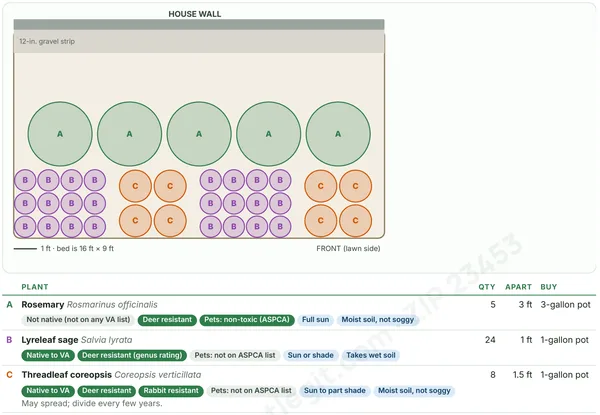
The Southeast Virginia guide suggests sketching a basic bed, about 10 by 5 feet, on a grid at 1 inch = 1 foot. Draw a circle for each plant at roughly its full size (SEVA guide). Its design tips:
- Smaller plants in front or on the sides, taller plants in the center or back.
- Plant in drifts: at least 3–5 plants of each kind instead of one of everything. It helps pollinators find food and looks less cluttered.
Step 5: Count your plants
Virginia Cooperative Extension's rules, written for rain gardens, work for any native bed (VCE 426-043, SPES-13P):
- Species: about one per 10 to 20 square feet.
- Groups: three to five of the same plant together.
- Spacing: by mature width. An inkberry that grows 4 feet wide goes 4 feet apart. Perennials go close enough that their leaves grow together and cover the ground.
| Bed size | Species (1 per 10–20 sq ft) | Plants (groups of 3–5) |
|---|---|---|
| 10 × 5 ft (50 sq ft) | 3–5 | about 9–25 |
| 10 × 10 ft (100 sq ft) | 5–10 | about 15–50 |
| 16 × 9 ft (144 sq ft) | 7–14 | about 21–70 |
Ranges are simple math from the Extension rules above. Big shrubs bring the count down; small perennials push it up. Check each plant's mature width on the tag.
Step 6: Set your planting calendar
- When to plant: in coastal Virginia, the Virginia Native Plant Society's South Hampton Roads chapter calls autumn "the best time of year to plant in our region," with mid-to-late October into early November ideal for roots to establish (VNPS South Hampton Roads). Elsewhere, ask your Extension office. Our page on when to plant trees and shrubs has more.
- First season: about 1 inch of water a week unless it rains (VCE 426-043).
- Winter: leave perennial and grass stems standing, then cut them back in spring just before new growth (VCE 426-043).
- Year 1 looks thin. That's normal. Here's what year 1 looks like.
Free tools vs. a plan made for your ZIP
| Free tools give you | My Yard Plan ($11.99) adds |
|---|---|
| Native plants for your area (NWF, Audubon, state guides) | Beds drawn to scale, showing where each plant goes |
| Whether a plant is invasive or regulated (PlantLegit's free check) | How many of each plant to buy, how far apart, and a shopping list |
| Your zone (USDA map) | Every plant checked against your state's lists, with the source cited |
| Local advice (your Extension office) | A month-by-month calendar with your area's average last-freeze date |
The sample plan for ZIP 23453 in Virginia Beach is 43 pages and covers 36 plants. Yours is built the same way for your ZIP.
Start free: check your ZIP. See which plants fit your ZIP and which ones your state lists as invasive, before you buy anything.
Want it laid out for you? My Yard Plan ($11.99): plants picked for your ZIP with each one’s legal status cited, beds drawn to scale with plant counts and spacing, a shopping list, and a month-by-month calendar. Delivered in 24 hours or a full refund. Get my plan · See a sample plan →
Soggy spot or downspout to deal with? The $49 Rain Garden + Yard Drainage Pack sizes a rain garden from your roof, draws a to-scale layout with a plant list checked for your ZIP, and gives 7 numbered build steps, downspout fixes and a shopping list. It includes your $11.99 My Yard Plan. See if it covers your ZIP →
Common questions
Is there a free native plant finder by ZIP code?
Yes. The National Wildlife Federation Native Plant Finder and the Audubon Native Plants Database both suggest native plants for your location, and the USDA Plant Hardiness Zone Map has a ZIP search. PlantLegit’s free check also shows which plants fit your ZIP and which ones your state lists as invasive.
How many plants do I need for a native garden bed?
Virginia Cooperative Extension’s rule of thumb is one species per 10 to 20 square feet, planted in groups of three to five. A 10 by 5 foot bed (50 square feet) works out to about 3 to 5 species, so roughly 9 to 25 plants depending on how big they get.
How far apart should native plants be?
Space by mature width. Virginia Cooperative Extension’s example: an inkberry that grows 4 feet wide is planted 4 feet apart on center, so shrubs touch at maturity without crowding. Perennials are spaced so their leaves grow together and cover the ground.
Related: native plants for your ZIP code · My Yard Plan · rain garden planting plan · planting zone by ZIP